.png)
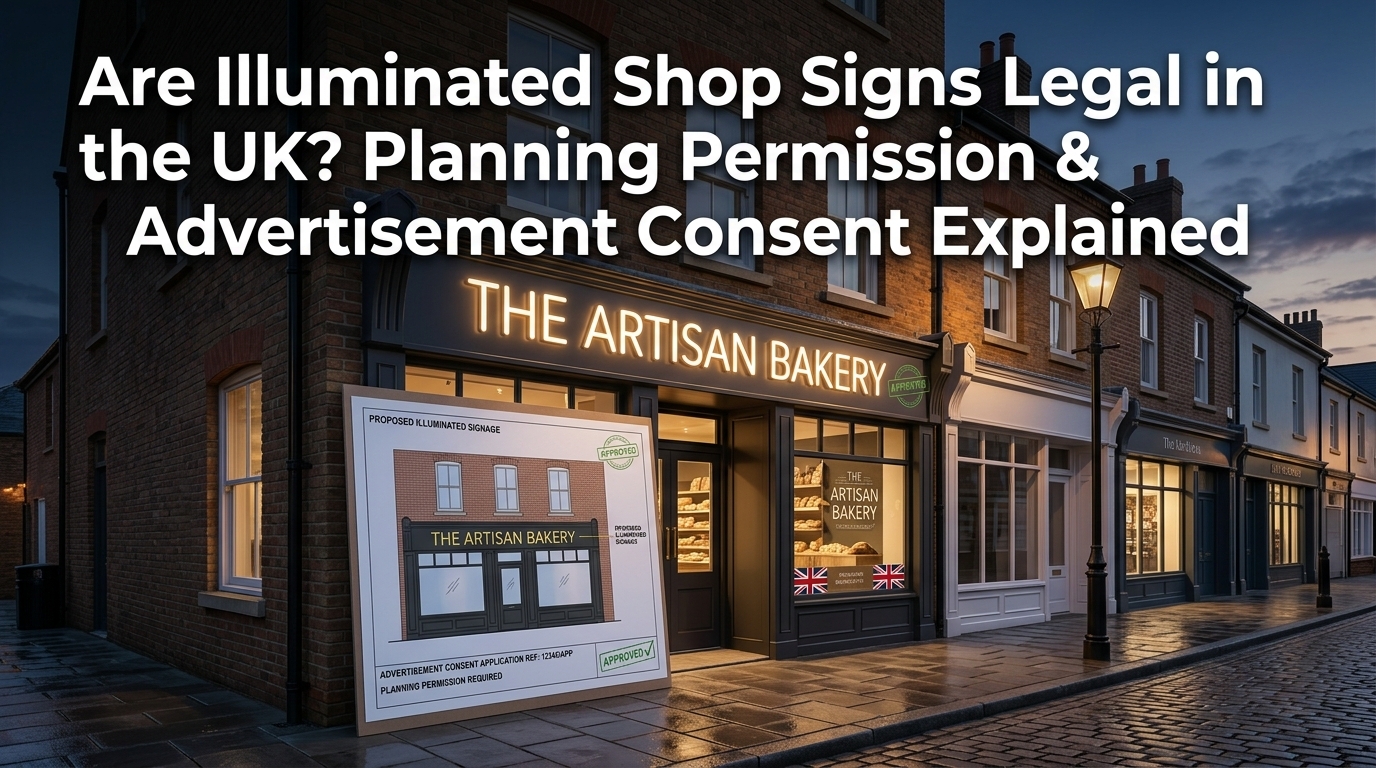
An illuminated shop sign can make a business stand out after dark, attract attention from passing customers and give a storefront a strong visual identity. But before installing a bright LED logo, neon sign or illuminated fascia, there is an important question to answer: do you need planning permission for a shop sign?
In the UK, the answer is not always straightforward. Many outdoor business signs are controlled through the planning system, and planning permission illuminated sign UK searches often lead to confusion between planning permission, advertisement consent and listed building consent.
The good news is that having an illuminated sign does not automatically mean your project cannot go ahead. In many cases, signage can be installed legally if it falls within permitted or deemed-consent rules. However, the exact requirements depend on factors such as the sign's size, position, illumination, building, location and local planning policies.
This guide explains the rules in simple terms, including when illuminated shop sign planning permission may be required, how advertisement consent works, what happens with listed buildings and conservation areas, and what to check before ordering or installing a sign.
Do You Need Planning Permission for an Illuminated Shop Sign in the UK?
An illuminated shop sign may require advertisement consent, but not every sign automatically needs a separate planning application. The rules depend on the type of advertisement, its location, dimensions, illumination and whether it qualifies for deemed consent.
The distinction between planning permission and advertisement consent is important. Outdoor advertising is controlled through a specific planning regime. The Planning Portal states that the majority of illuminated signs normally require advertisement consent, although some signs can benefit from deemed consent if they satisfy specific conditions.
For a typical business, this means you should not simply assume that a small LED or neon sign is automatically exempt.
A sign attached to a shopfront can look relatively simple from the street, but the council may consider factors such as its size, position, projection, brightness and relationship with the surrounding building.
If you are planning a new illuminated sign, the safest approach is to establish what consent applies before manufacturing or installing it.
What Is Advertisement Consent?
advertisement consent is a specific form of planning control covering outdoor advertisements and signs.
The government defines an advertisement broadly to include signs, letters, boards, devices and other representations used for advertising, announcements or directions, whether illuminated or not.
This can include common commercial signage such as:
Illuminated fascia signs
Projecting shop signs
Neon signs
LED signs
Canopy signs
Pole signs
Directional advertising
Certain illuminated displays
The important point is that advertisement consent is primarily concerned with amenity and public safety. The local planning authority considers how the sign affects the appearance of the area and whether it could create safety problems, such as glare, distraction or interference with road users.
Some advertisements have deemed consent, meaning they can be displayed without applying for express consent if all relevant conditions are satisfied. Others require express advertisement consent from the local planning authority.
Planning Permission vs Advertisement Consent: What's the Difference?
One of the most common sources of confusion is treating planning permission and advertisement consent as exactly the same thing.
They are related, but they are not identical.
Planning permission generally deals with development and changes to land or buildings.
Advertisement consent deals specifically with the display of advertisements and signs.
For a shop owner installing an illuminated sign, advertisement consent may be the relevant approval rather than a standard planning application for the building itself.
However, a project can potentially involve more than one type of consent. For example, a sign installed on a listed building may also require listed building consent because of its effect on the historic character of the property.
This is why asking simply, "Do I need planning permission?" can sometimes produce an incomplete answer. The better question is:
What permissions or consents are required for this specific sign, on this specific building, in this specific location?
When Is Advertisement Consent Required for Illuminated Signs?
The majority of illuminated signs are normally subject to advertisement consent, although certain advertisements can benefit from deemed consent if they meet the relevant requirements.
The exact assessment can depend on details that are easy to overlook.
For example, the council may consider the sign's:
Overall dimensions
Height above ground
Position on the building
Projection from the wall
Letter or logo size
Lighting method
Brightness and illumination
Relationship with windows and neighbouring properties
Impact on pedestrians and road users
Location within a conservation area or historic setting
A sign that complies with the relevant conditions may have deemed consent, while a visually similar sign with different dimensions or illumination may require an application.
This is why there is no universal "maximum neon sign size" that guarantees approval throughout the UK.
Local planning authorities can also have their own policies and design guidance, so checking with the relevant council is important.
What Are the Main Illuminated Sign Regulations in the UK?
When assessing illuminated sign regulations UK, it helps to think about three broad areas: appearance, safety and location.
The first is visual impact. A sign should be appropriate to the building and surroundings rather than appearing excessively large, bright or visually dominant.
The second is public safety. Government guidance states that advertisements must not create hazards for road, rail, waterway or aircraft traffic, and illuminated signs should not create inappropriate glare, dazzle or confusion with official signals.
The third is the character of the location. A sign in an ordinary modern retail area may be treated differently from signage attached to a historic building or located within a sensitive conservation area.
This means that the same neon design could potentially face different planning considerations depending on where it is installed.
Can You Install an LED Neon Sign Without Planning Permission?
Possibly, but you should not assume that LED technology automatically makes a sign exempt.
LED neon is simply a type of illuminated signage. From a planning perspective, the authority is interested in the advertisement and its effects, not simply whether the light source is LED.
Some councils have specific local guidance that sets out circumstances in which certain illuminated shop signs may qualify for deemed consent. For example, local restrictions can cover the type of illumination, location, height and projection of a sign.
Therefore, if you are considering an LED neon sign for a shop, restaurant, café or other commercial premises, check the relevant local rules before installation.
This is particularly important if the sign will be:
Highly visible from a public road
Large or brightly illuminated
Projecting significantly from the building
Installed above a shopfront
Located in a conservation area
Attached to a listed building
Close to a junction or traffic signals
What About Traditional Neon Signs?
Traditional glass neon and modern LED neon can look similar, but their construction and electrical systems are different.
Traditional neon typically uses glass tubes filled with gas and high-voltage equipment. LED neon uses LEDs within flexible illuminated tubing.
From a design perspective, both can be used for shopfronts, restaurants, bars and hospitality businesses. From a planning perspective, however, the key issue is not simply whether the sign uses traditional neon or LED.
The council may assess the illumination, brightness, size, positioning and visual impact of the proposed advertisement.
This is why changing from glass neon to LED does not necessarily remove the need to investigate advertisement consent.
Do I Need Permission for a Small Shop Sign?
A small sign is not automatically free from planning controls simply because it is small.
There are various classes and conditions under the advertisement regulations, including provisions for deemed consent. Whether a particular sign qualifies depends on its circumstances and whether it satisfies the relevant requirements.
For example, factors such as the sign's relationship to the business operating at the premises, its dimensions, position and illumination can all matter.
This is particularly important when dealing with illuminated signs because illumination can change the planning position compared with an otherwise similar non-illuminated sign.
The Planning Portal specifically notes that the majority of illuminated signs normally need advertisement consent, while some advertisements can benefit from deemed consent depending on their circumstances.
Are There Special Rules for Listed Buildings?
Yes. Listed building neon sign rules require additional care.
If your shop, restaurant or commercial premises is a listed building, installing an illuminated sign can affect the building's architectural or historic character.
In these circumstances, advertisement consent may not be the only consideration. Listed building consent may also be required for works affecting the listed building. Government guidance states that even where an advertisement does not require express advertisement consent, other statutory requirements can still apply, including listed building consent.
Local planning authorities can be particularly careful about signage attached to listed buildings. The Planning Portal advises that special care should be taken with signs displayed on or close to listed buildings so they do not detract from the building's character and appearance.
For a listed property, do not manufacture and install the sign first and investigate permissions afterwards.
The design may need to consider the existing façade, fixing points, materials, illumination and the visual relationship between the sign and historic architectural details.
What If the Shop Is in a Conservation Area?
Conservation areas can have additional planning sensitivity because the appearance and character of the wider area are protected.
An illuminated sign that might be acceptable on a modern high street could receive greater scrutiny in a historic shopping street.
The council may consider whether the sign is appropriate in terms of:
Brightness
Colour
Size
Materials
Lettering style
Position
Projection
Relationship with neighbouring buildings
Some local authorities publish specific design guidance for shopfronts and advertisements in conservation areas.
Because local policies differ, it is important to identify whether your premises sits inside a conservation area before finalising your signage design.
Can a Council Refuse an Illuminated Shop Sign?
Yes. Where express advertisement consent is required, the local planning authority assesses the proposal primarily in relation to amenity and public safety.
A refusal does not necessarily mean illuminated signage is prohibited. It can mean that the specific proposal creates concerns that could potentially be addressed through a revised design.
For example, a council could have concerns about excessive brightness, poor positioning, visual clutter, obstruction or impact on road users.
A more restrained design may be easier to justify than an oversized or highly bright installation.
This is why professional sign design should consider planning requirements from the beginning rather than treating compliance as something to deal with after the artwork has been finalised.
What Makes an Illuminated Sign More Planning-Friendly?
There is no single design that guarantees approval, but a well-considered sign is generally easier to assess than one that ignores its surroundings.
A good starting point is to make the sign proportionate to the building. The sign should communicate the business name or branding clearly without overwhelming the shopfront.
Illumination should also be appropriate for the setting. A softly illuminated sign can provide excellent visibility without creating the glare associated with excessively bright signage.
Static illumination is often easier to manage than rapidly changing or flashing displays. Government guidance specifically highlights potential public-safety concerns associated with illuminated signs that could distract road users or create glare and confusion.
The fixing method should also be considered. A sign that requires significant alterations to a historic façade may raise additional concerns compared with a carefully designed installation.
What Information May Be Needed for an Advertisement Consent Application?
If your sign requires express advertisement consent, providing clear information can make the proposal much easier for the planning authority to assess.
The Planning Portal application guidance asks for details such as the dimensions, height, materials, colours, projection and illumination of proposed advertisements. For illuminated signs, information about the illumination and whether it is static or intermittent is also relevant.
A well-prepared proposal will therefore normally need more than a simple picture of the proposed logo.
Depending on the project and authority, you may need information showing:
The proposed sign design
Sign dimensions
Position on the building
Height above ground
Projection from the façade
Materials
Colours
Illumination method
Lighting characteristics
Existing shopfront context
Proposed installation details
Providing accurate information is important because the council needs to understand what you actually intend to install.
How to Check If Your Shop Sign Needs Permission
Before ordering an illuminated sign, start by identifying the exact location of the premises and the local planning authority responsible for it.
Then check the council's planning and advertisement-signage guidance. The Planning Portal also recommends contacting the local planning authority when you need advice about a specific proposal.
Next, determine whether the building is listed or located within a conservation area. This can materially affect the planning considerations.
Then prepare the basic sign information: dimensions, position, materials, colours, illumination type and brightness.
If you are uncertain, consider seeking pre-application advice from the local authority before committing to manufacture.
Most importantly, do not assume that a sign is legal simply because another business nearby has a similar sign. That other sign may have different permissions, may benefit from different circumstances or may have been installed under older rules.
What Happens If You Install a Sign Without Required Consent?
Displaying an advertisement that requires express consent without obtaining it can create a serious planning issue.
Government guidance states that displaying an advertisement without the required consent is a criminal offence.
That makes checking the planning position before installation particularly important.
The potential problem is not limited to the cost of producing the sign. If the installation has to be altered or removed, you could also face additional manufacturing, installation and replacement costs.
For a business, this can be especially frustrating because a sign is often ordered specifically for a particular shopfront and brand design.
The simplest way to reduce that risk is to establish the planning requirements before placing the final production order.
Does the Sign's Brightness Matter?
Yes. Brightness is an important consideration for illuminated signage.
An illuminated sign should provide enough light to communicate the business identity without creating excessive glare or distraction.
Government guidance identifies concerns where illuminated signs could create glare or dazzle, distract road users, be confused with traffic signals or otherwise affect transport safety.
This is particularly relevant for shops located close to busy roads, junctions and pedestrian crossings.
A sign designed for a quiet interior-facing environment may therefore need a different lighting approach from a large roadside business sign.
For LED neon, controllable brightness can also be useful because it gives the business greater flexibility to create a visible sign without unnecessarily using maximum illumination at all times.
What About Electrical and Building Safety?
Planning consent is not the only consideration when installing an illuminated sign.
The electrical installation also needs to be safe and suitable for the environment. Planning Portal guidance notes that while domestic adverts and signs are not normally subject to building control, electrical work associated with a lit sign is subject to relevant requirements. Signs must also be kept in a safe condition.
For a commercial installation, the sign should therefore be designed and installed appropriately rather than treating the electrical connection as an afterthought.
A professional sign supplier or qualified installer can help ensure that the power supply, wiring, mounting system and illumination are appropriate for the intended installation.
A Practical Example: Installing a Neon Sign for a UK Restaurant
Imagine a restaurant wants a custom LED neon sign displaying its name above the entrance.
The business owner might initially think the project is simple: choose the logo, order the sign and mount it above the door.
A better process starts with the property itself.
First, the owner checks the local planning authority and confirms whether the property is listed or inside a conservation area.
Next, the proposed sign is assessed for its dimensions, projection and position. The owner then considers whether the illumination is static, how bright it will be and whether it could affect nearby road users.
The business can then determine whether the sign benefits from deemed consent or whether an advertisement consent application is necessary.
Only after the planning position is clear should the final manufacturing specifications be approved.
This approach reduces the chance of designing a beautiful sign that later has to be changed because of planning requirements.
7 Things to Check Before Ordering an Illuminated Shop Sign
Installing an illuminated sign is much easier when planning considerations are addressed before production.
Before placing your order, establish:
Who is the local planning authority?
Is the property listed?
Is the property in a conservation area?
What are the proposed sign dimensions?
Where exactly will the sign be positioned?
How will the sign be illuminated and how bright will it be?
Does the proposal require advertisement consent or another form of approval?
These questions provide a practical starting point for most businesses.
If the council requires an application, you can then prepare the sign drawings and technical information around the actual planning requirements rather than guessing what might be acceptable.
Are Illuminated Shop Signs Legal in the UK?
Yes, illuminated shop signs can be legal in the UK, but the sign may require advertisement consent and must comply with applicable planning and safety requirements.
There is no blanket rule that makes all illuminated shop signs illegal or that automatically allows every LED neon sign.
Instead, the legal position depends on the individual advertisement, its location, dimensions, illumination and relevant planning controls.
Many advertisements can benefit from deemed consent when they satisfy the applicable conditions, while other signs require express consent from the local planning authority.
Listed buildings, conservation areas, unusual installations and signs with significant illumination may require particular care.
That is why the best approach is to treat planning as part of the sign-design process rather than something to investigate after installation.
Final Thoughts
Understanding planning permission illuminated sign UK requirements before ordering your signage can save a business significant time, money and frustration.
The key point is that there is no single rule covering every shop sign. An illuminated fascia, projecting neon sign, LED logo and large external display can all have different planning considerations depending on where and how they are installed.
For most businesses, the first step is to identify the local planning authority and check whether the proposed sign requires advertisement consent or qualifies for deemed consent. If the premises is listed or located within a conservation area, additional checks may be necessary.
A well-designed illuminated sign should do more than look attractive. It should be appropriately sized, safely installed, suitable for its surroundings and designed with the relevant planning requirements in mind.
If you are planning a new LED neon or illuminated shop sign, establish the permission requirements before production and installation. That simple step can help ensure your finished signage is not only eye-catching but also compliant with the rules that apply to your premises.